Medián’s mandate estimate
The seat calculation is in fact an estimate, based on the results of Medián’s five most recent representative surveys. The probable values can only be determined responsibly within a certain range.
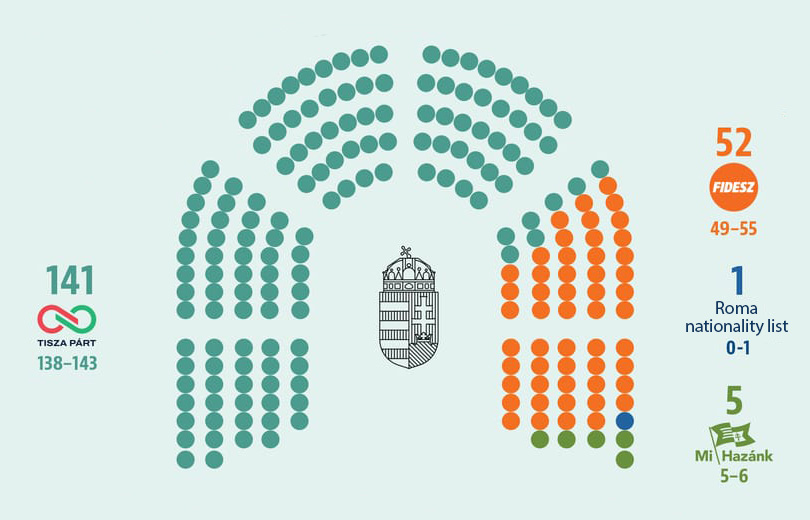
Note: the larger numbers in the chart indicate the projected number of seats, while the smaller numbers show the bounds of the estimate.
Voter realignment: Where did they come from—and where did they go?
Fidesz has lost a quarter of its 2022 voter base, and the attrition among former governing party supporters has remained significant even since the European Parliament elections. Party preference continues to be determined primarily by age, and secondarily by level of education, while the impact of place of residence is becoming less significant.
In the last week of February and throughout March, Medián conducted five representative telephone surveys, using three different call centres, on a total sample of 5,000 respondents. Some of these, by the nature of the commission, had not previously been made public; however, the aggregated dataset now allows for a more reliable analysis of certain patterns than usual. Shortly before the election, 48 percent of the voting-age population would vote for the Tisza Party, 30 percent for Fidesz, 4 percent for Mi Hazánk, 2 percent for DK, and 1 percent for MKKP, while 15 percent either did not know or did not wish to answer, or were certain that they would not vote.
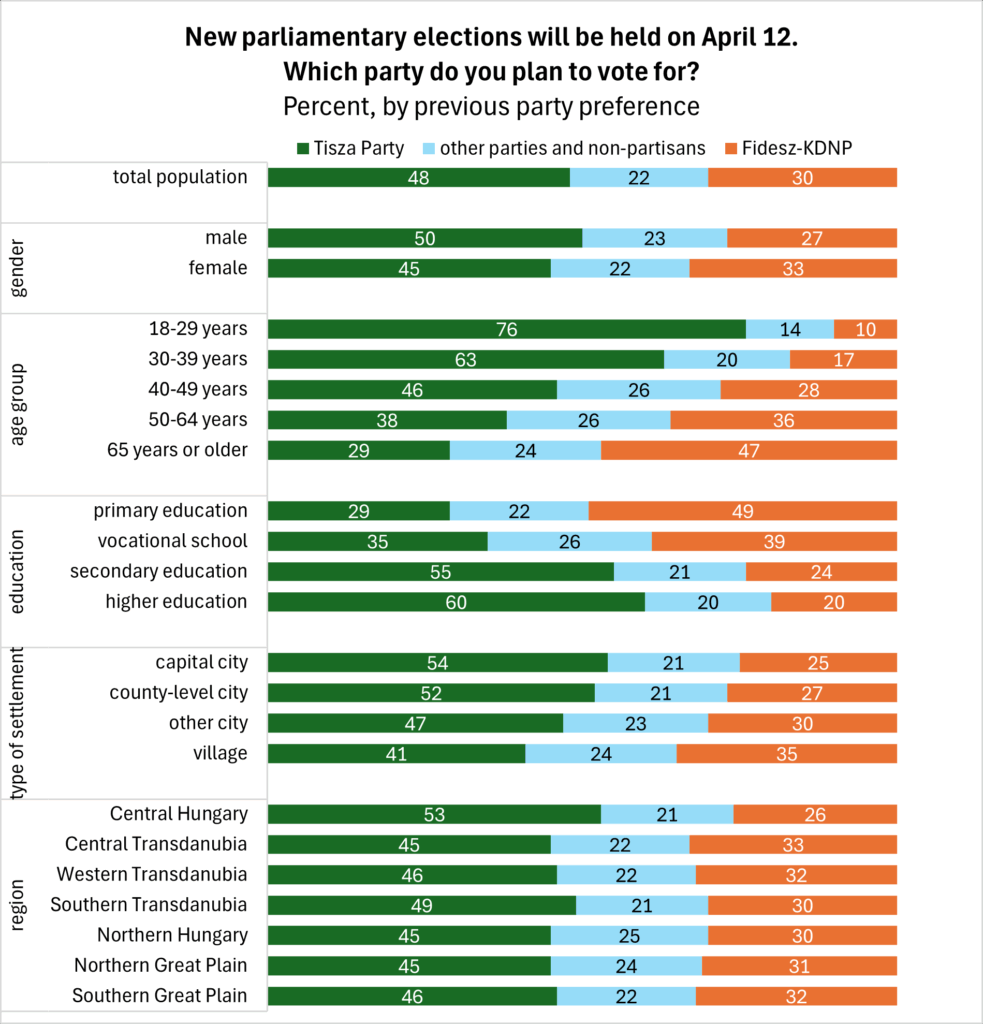
The Tisza Party is strongest among young voters, and its support is increasing month by month. Three-quarters of those under 30 would vote for the Tisza Party, and 63 percent of those aged between 30 and 40 would also support them. Fidesz’s support in these two age groups is only 10 and 17 percent, respectively. Fidesz holds an advantage only among pensioners: nearly half of those over 64 support the governing party, and only 29 percent of them would vote for Tisza.
Differences by level of education are also significant: an absolute majority of university graduates and those with a secondary school diploma support Tisza, while only around a quarter to a fifth of them back Fidesz. Among those with vocational training, Fidesz holds a slight lead, whereas among those with only primary education or less, its advantage is already substantial: 49 percent support Fidesz compared with 29 percent for Tisza.
Differences by type of settlement are no longer as pronounced. It remains true that the larger the settlement, the higher the share of residents supporting Tisza, while the smaller the settlement, the more popular Fidesz is. Even so, in the March surveys Tisza is already ahead in villages as well, leading Fidesz by 41 to 35.
The narrowing gap between settlement types is also reflected in the minimal differences across regions. While Central Hungary is somewhat more “pro-Tisza,” in all other regions support for Péter Magyar’s party ranges between 45 and 49 percent, compared with 30 to 33 percent for the governing party. This suggests that Tisza’s voter base has indeed grown in a broadly uniform way across the country, from villages to the capital.
Beyond analysing the main social groups, Medián’s researchers also compared current voting intentions with past electoral preferences. As the Tisza Party did not yet exist at the time of the 2022 parliamentary election, it is particularly revealing to examine where its current voters have come from. Nearly nine-tenths of those who supported the opposition alliance led by Péter Márki-Zay have since shifted to Tisza, while close to half of voters of other parties, and more than half of those who did not vote at the time, would now vote for Tisza. Péter Magyar has even managed to attract around one-eighth of former Fidesz voters. By contrast, Fidesz has lost a quarter of its voters from four years ago, although 16 percent of those who did not vote then now sympathise with the party.
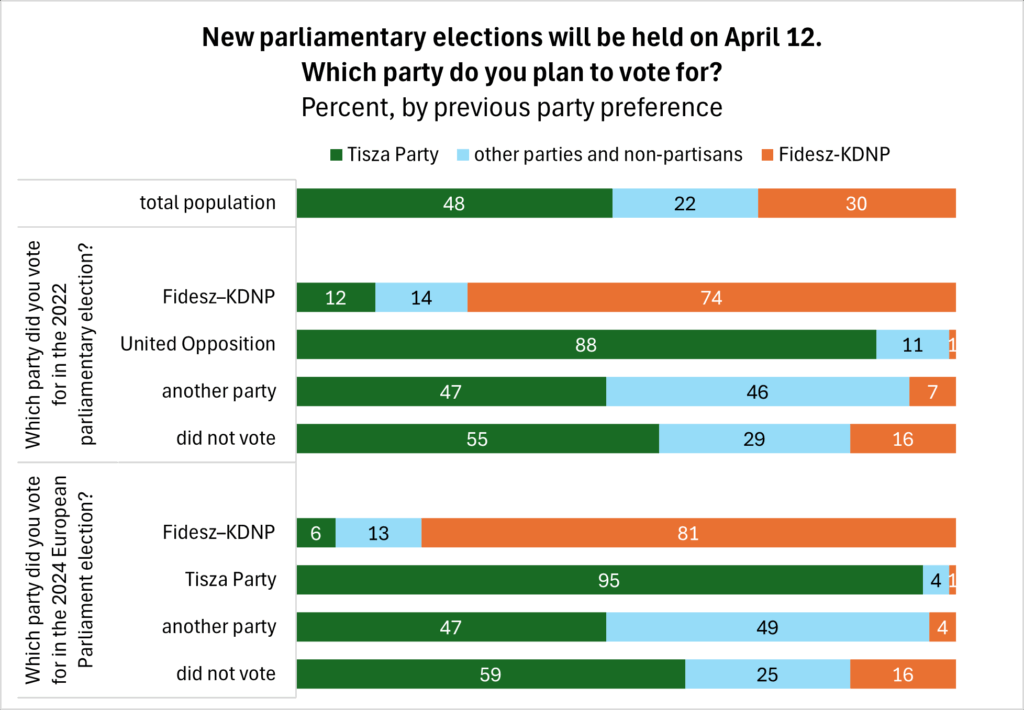
The 2024 European Parliament election was the Tisza Party’s first real test, when it secured 30 percent of the vote. Of those voters, 95 percent still support Tisza today. Beyond them, 47 percent of those who voted for other parties at the time, and 59 percent of those who abstained, would now vote for the list led by Péter Magyar on April 12. Fidesz has been less successful in retaining its supporters: eight-tenths of those who voted for the party in June 2024 would vote for it again in the 2026 parliamentary election, 6 percent have switched to Tisza, and 13 percent have become uncertain—either they would not vote or would instead support one of the smaller parties.
Based on respondents’ recollections of both the 2022 parliamentary election and the 2024 European Parliament election, the Tisza Party has been able to mobilise undecided voters and attract large numbers of supporters from other parties, while Fidesz, far from achieving similar success in appealing to voters without party affiliation, has not even managed to retain all of its own supporters. There are even some among them—albeit only a few percent—who have switched to Tisza.
What drives the vote?
From the promise of prosperity or security to ideological alignment, numerous factors influence why voters find one party or another more appealing. Medián also surveyed the individual motivations of voters.
Medián’s polls over the past few months have shown, month by month, how party support has evolved as the April 12 election approaches. However, less attention has been paid to the motivations behind voters’ decisions to support one party or another, or to the government and opposition narratives that successfully resonated with them as the campaign drew to a close. January survey by Medián (based on the usual representative sample of 1,000 respondents) also made it possible for respondents to explain, in their own words, the main reason why they would vote for their chosen party. While opinions naturally vary, the main motivations can be discerned from the data.
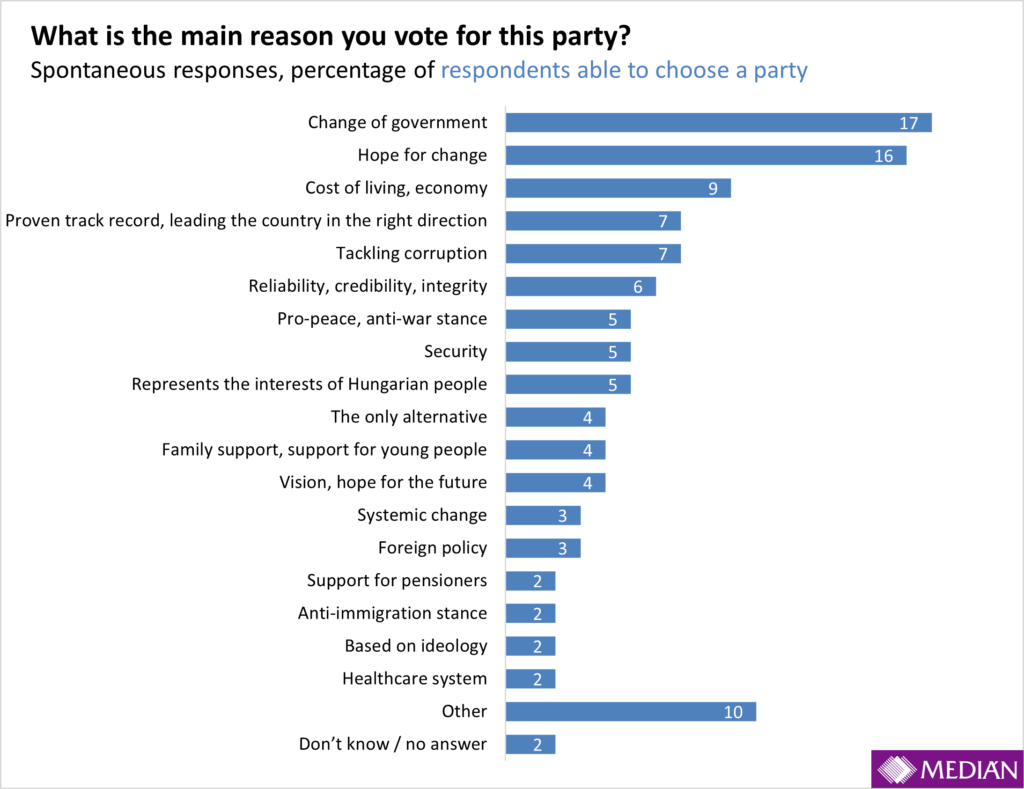
According to the survey, 17 percent of those who can choose a party are voting to bring about a change in government, while 16 percent are voting in the hope of change—these two reasons, expressed in different words but essentially identical, are the most common motivations for party choice this year. From here on, however, the arguments of the ruling party and the opposition alternate: many vote with their own livelihoods in mind, while others vote against nationwide corruption. Some believe the Orbán government has proven its competence, while others see credible and reliable alternatives in certain opposition parties; however, support for peace and opposition to war were cited just as frequently in the responses as the representation of the country’s and its people’s interests.
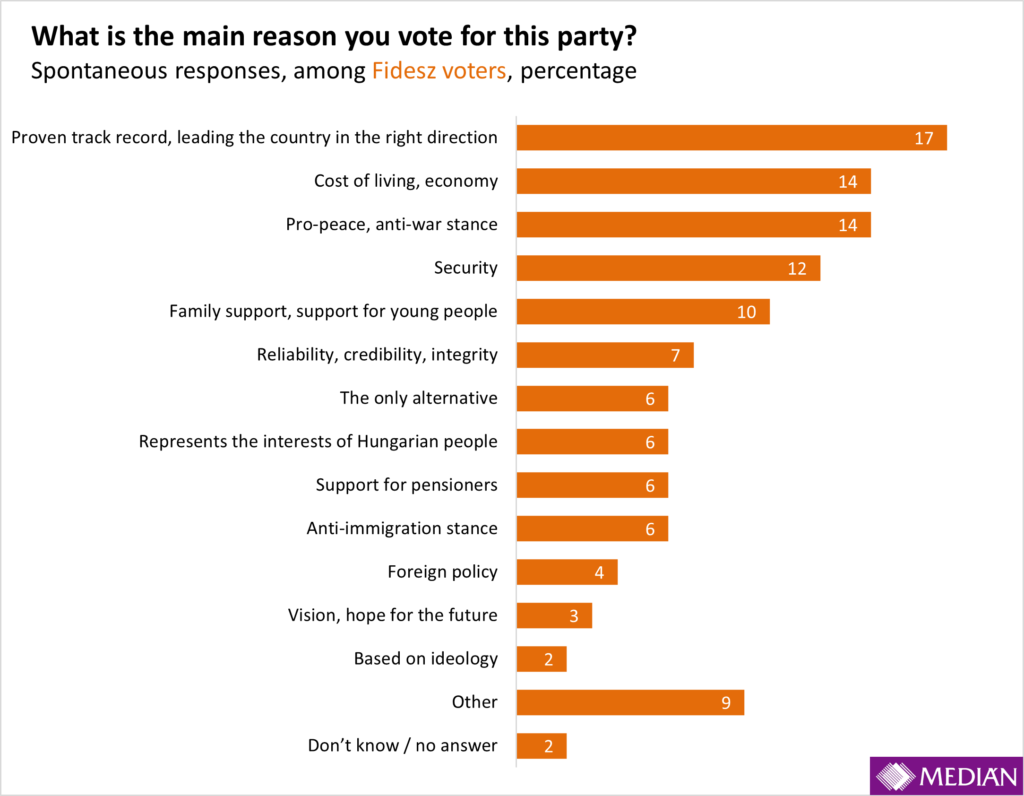
If we look only at the responses of Fidesz voters, the majority of them vote for the ruling party because they believe it has already proven that it is leading the country in the right direction: for 17 percent, this is the primary reason for their support of Fidesz. In second place—tied—are acceptance of the party’s rhetoric and economic reasons. Among the latter, most mentioned that they owe their own financial security to Fidesz. Many feel that they have never lived as well as they have in recent years. One in ten Fidesz supporters specifically mentioned support for families, while security was the main reason for 12 percent
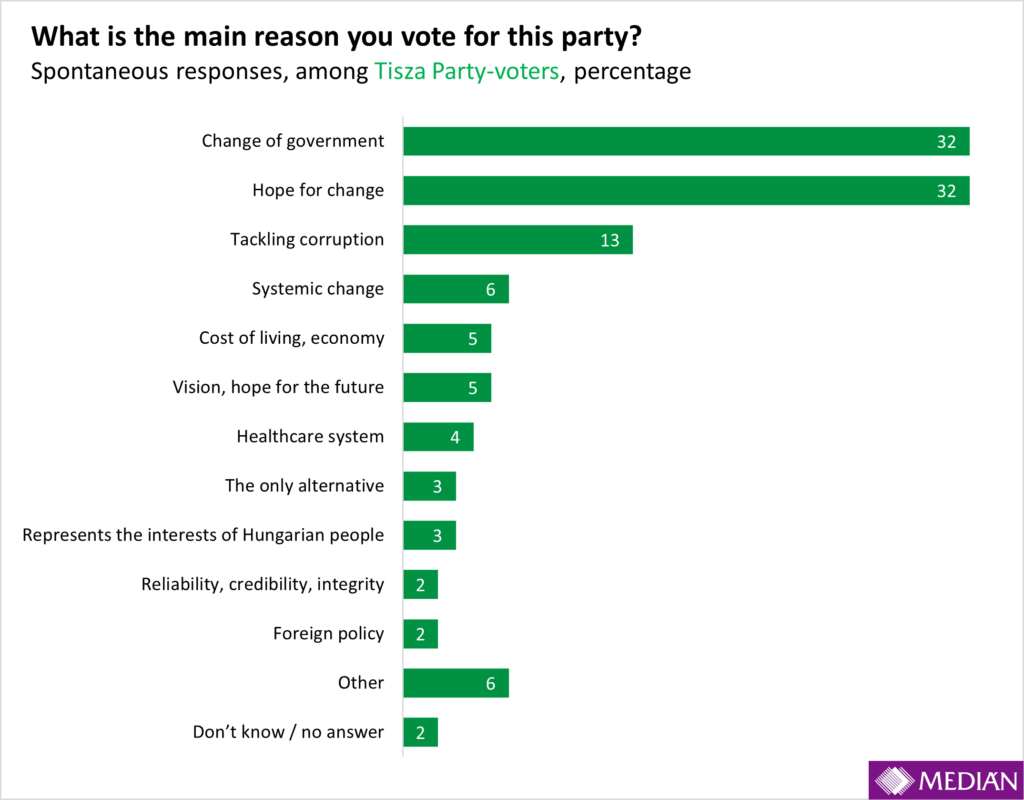
The motivations of Tisza voters are far less dispersed than those of Fidesz supporters. Thirty-two percent primarily back Péter Magyar’s party in order to bring about a change of government (with a further 6 percent explicitly calling for a systemic change), another 32 percent do so “in the hope of change,” and 13 percent because they expect a Tisza victory to eliminate corruption. No other reason exceeds 5 percent among Tisza voters, meaning that the overwhelming majority of supporters of the opposition grouping led by Péter Magyar are motivated primarily not by the party’s specific merits, but by opposition to the government.
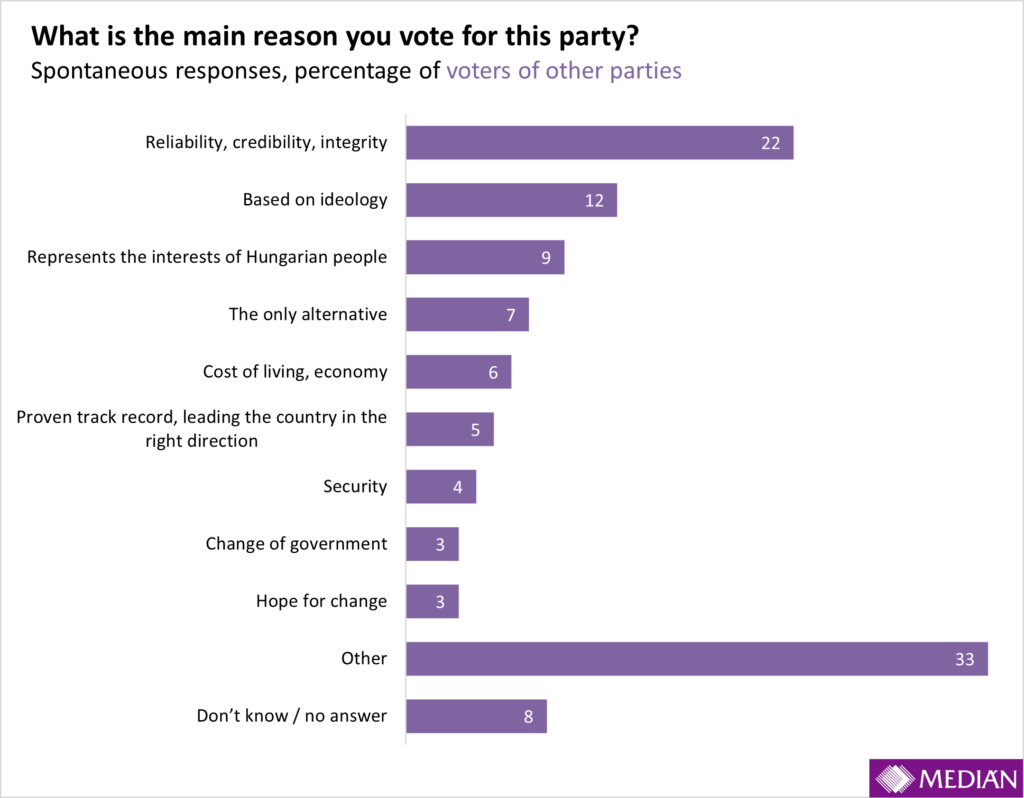
Supporters of other opposition parties form a significantly smaller group, even taken together, than those of Fidesz or Tisza. While it is difficult to identify a single unifying rationale among them, some patterns can still be observed. Voters of smaller parties are less motivated by opposition to the current government and more by the perceived value of their chosen party: 22 percent consider it trustworthy, credible or principled, while 12 percent base their choice on ideological grounds. The most common motivations nationwide—government change and change in general—appear only to a negligible extent in this group as primary reasons for voting.